The Minimum Wage Fallacy

Image of Money being placed in a wallet

Do you remember your first job?

Some rode newspaper routes. Others worked as short order cooks, bagged groceries or manned cash registers. If you were lucky you served as a lifeguard over the summer; the less fortunate among us might have done hard labor down on the farm or over at a construction site.

No matter what you did, there was a certain satisfaction to be gained when the paycheck rolled in from a hard week’s work. Of course, the money was secondary to what it represented: You earned something for your efforts.

Sure, having a few bucks for a movie or milkshake was great. But you could not put a price on the skills and responsibilities you developed. Showing up at a job on time, taking orders, volunteering to help your coworkers, putting the customer first, and always hustling would prove useful no matter what industry you ended up in.

And beyond these basic skills, that first job gave you a sense of purpose, dignity and pride.

When we hear politicians and pundits talk about minimum wage jobs today, it seems many of these folks forgot about these experiences. Or perhaps they never had them.

The chattering class narrative goes something like this: “People working minimum wage jobs cannot put food on the table for their families. Therefore, we must raise the minimum wage.”

Let’s put aside the economics and politics of the matter for a second.

Framing the issue as the chattering class does illustrate a fundamental misunderstanding about the nature of minimum wage jobs.

Some basic questions about the minimum wage shed light on this.

How old are most people working minimum wage jobs?

According to the Bureau of Labor Services’ (BLS) most recent report on the minimum wage, based on data from 2015: “Minimum wage workers tend to be young. Although workers under age 25 represented only about one-fifth of hourly paid workers, they made up about half of those paid the federal minimum wage or less.”

What kind of jobs do minimum wage earners hold?

The BLS report states: “Almost two-thirds of workers earning the minimum wage or less in 2015 were employed in service occupations, mostly in food preparation and serving related jobs.”

In other words, these are basic jobs like the ones we held when we were kids.

Do most minimum wage earners support families?

In 2015, 931,000 of the 2.6 million Americans ages 16 or older earning minimum wage or less – or approximately 36% of all such workers – were either married with a spouse present, or had a marital status of “other.”[i]Thus, the vast majority did not consist of families.

How many workers earn minimum wage or less relative to the total size of the American workforce?

The 2.6 million Americans ages 16 or older earning the federal minimum wage or less in 2015 represented 3.3% of the 78.2 million such workers paid at hourly rates. Since 58.5% of all workers are paid at hourly rates, that means that just under 2.0% earned the federal minimum wage or less.

So the minimum wage mainly impacts young, low-skilled workers, who have not started families, representing a fraction of the U.S. workforce.

Does that square with the critiques that start from the premise that the minimum wage must be high enough to support a family?

Clearly the answer is “no.” Most of the Americans impacted by the minimum wage are too young to have started a family, or otherwise not ready to do so.

Of those who do have a family to support, which represents a fraction of a fraction of the American labor force, some are likely to be early in their careers, seeking out lower-paying opportunities as a springboard to better ones.

That is of course the real purpose of minimum wage work: To build one’s resume, break into an industry and learn valuable skills. The small amount paid out in wages does not account for the total value of the job – the education, the experience and the contacts. These are all essential elements towards building a career – and fast transitioning out of a minimum wage job towards more challenging and rewarding opportunities.

There is another thing that is missed in this minimum wage conversation.

Calls to raise the minimum wage significantly deprive America’s youth of an opportunity that we once had – to work as kids – that served us well in life.

As basic economics tells us, the higher the minimum wage above what the market will bear, the lower the quantity of minimum wage jobs there will be. If you are in the restaurant business and you can only afford to hire a limited amount of workers because of the increased cost, chances are you are going to hire the more experienced worker rather than the high school kid. You will not want to waste time and money on training.

The minimum wage narratives we so often hear are not only inaccurate, but they can lead to policies detrimental to our children and grandchildren.

We must put them in their proper context as one piece – a critical steppingstone — in the great puzzle that is the American labor force.

Museum of American Finance Annual Gala

Image of Museum of Finance Awards Gala

What a wonderful evening we had in New York last Wednesday at the Museum of American Finance’s annual gala. This is always a great event, held to support an important and deserving institution, but this year I found it especially meaningful, as the museum used the occasion to honor me with its Charles Schwab Financial Innovation Award. Introduced just last year and named after my business competitor and friend Charlie Schwab (who quite appropriately was the award’s first recipient), the award is meant to recognize individuals who have introduced new markets or new financial instruments to our financial system. While I’ve never been one to seek out awards and testimonials, I’m enormously proud of the role TD Ameritrade has played in helping to make financial markets more accessible to everyone, and the fact that our peers in the financial-services industry have seen fit to recognize our contributions is a wonderful thing.

The museum, of course, exists not simply to educate us about the history of American finance, but also to remind us of the absolutely essential role that finance plays in making possible the thing that makes America strong and prosperous – our system of free enterprise. That’s not to say there aren’t important lessons to be learned from our history. As I told the group in my acceptance speech, it’s worth remembering what gave us our start in the financial-services business: the 1975 deregulation of the commission structure, which ultimately made the stock market accessible to millions of small investors. Deregulation was a good thing then and I strongly believe it can be a good thing now.

What made the evening at the museum particularly special was to be surrounded by so many dear friends and loved ones, including my wife Marlene, my children and their spouses, and colleagues from TD Ameritrade with whom I worked shoulder-to-shoulder through so many adventures. All in all, an evening to remember. It just doesn’t get better than this.

Students’ quest for knowledge begins anew as NGL Academy, an unconventional school, opens in Bellevue

It continues to be an exciting time for us at Opportunity Education.

By Emily Nitcher / World-Herald staff writer
Aug 22, 2017
Omaha World-Herald Article

There are no classrooms made up of tidy little rows of desks facing one direction at the NGL Academy.

It’s not that kind of school.

Students should expect activity, said Mark Smith, director of the academy. Teachers move around the room asking students questions and helping them dig deeper into topics. Students should not be sitting in the classroom watching one person talk. Instead, they actively work alone or together with an instructor.

Classes begin today at the unconventional school on the campus of Bellevue University. Eleven ninth-graders from Omaha and Bellevue have signed up to be in the inaugural class. Ray Ravaglia, NGL Academy’s chief learning officer, said all of the students are on scholarships.

The Bellevue high school is the first NGL Academy to open. It will be followed by a second school in Santa Rosa, California, next month.

The schools are backed by Omaha-based Opportunity Education, which was started in 2005 by TD Ameritrade founder Joe Ricketts. Gov. Pete Ricketts, Joe Ricketts’ son, is on the nonprofit’s board of advisers, according to the foundation’s website.

The academy uses Next Generation Learning curriculum developed by Opportunity Education, which is designed to teach students how to learn. Students use technology and go on personalized learning projects called “quests.”

Teachers serve more as mentors, challenging and engaging students instead of lecturing.

There’s a chance that this year’s class could expand by a few more students, Ravaglia said. The plan is to add more grades and more students in the coming years.

First, school leaders had to find the first batch of students. That proved to be an adventure.

Ravaglia said school officials had to go out and make connections with people to make sure they understood the core mission of the school.

“So, as you can imagine, some people liked what we had and just bought into it right away,” he said. “Others were more hesitant.”

Among the concerns for parents was whether the school was accredited.

All public schools in the state of Nebraska need to be accredited and all nonpublic and parochial schools need only to be approved by the state, but also can become accredited if they choose, said David Jespersen, a spokesman for the State Department of Education. NGL Academy has been approved, he said.

Despite some early confusion, it is not an online school.

There’s a technology component, officials said, but it doesn’t take over teaching.

In fact, school officials want to create partnerships with the broader community to give students new experiences in and out of the classroom.

The school already has a joint program with the Omaha Conservatory of Music. Students will take a bus to the conservatory one day a week for about three hours to learn about music theory and composition.

After months of planning, Smith and Ravaglia said they’re excited to get students in the classroom.

The academy is still looking for future students. Those interested can visit ngl.academy.

Pride and Reassurance

Photo of Joe Ricketts and family

I’ve written before on this blog about  how Marlene and I raised our children not only to be self-reliant and hard-working, but also to believe in the importance of public service. So it shouldn’t come as a surprise to anyone how proud I am that President-elect Trump has asked my son Todd Ricketts to serve in his administration as Deputy Secretary of Commerce.

As far as I am concerned, there is no challenge facing our great nation more pressing than the need to get our economy back on track. The Obama legacy of higher taxes and government interference has been leading us down an unsustainable path that if unchecked would have led to disaster, stifling the engines of economic opportunity and further crippling the middle class. The fact that Mr. Trump has called on Todd to help him reverse this unacceptable drift is not only a source of great pride to me but also a reassurance that the country may once again be headed in the right direction.

Bleeding Cubbie Blue

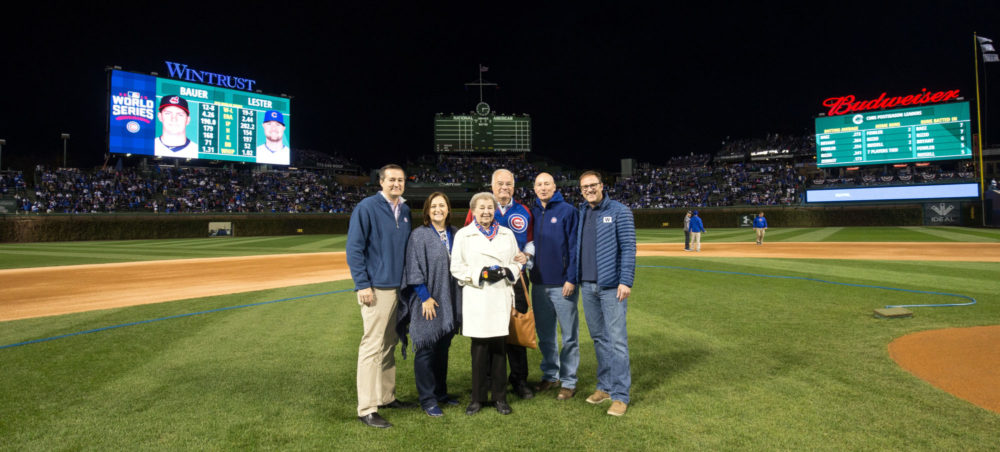
Image of Ricketts family on Chicago Cubs field

Watching the World Series, I kept thinking how baseball is a game of moments.  The moment when the pitcher releases the ball.  The moment the batter swings at, or takes the pitch.  The moment the infielder dives for a catch.

How the players respond to these moments produces opportunities and challenges.  And watching all this, I realized it’s a lot like life.

It’s no secret that while my four children and wife are avid baseball fans who bleed Cubbie blue, I’ve never been a sports buff.  But over the past six months, as I watched the Cubs seize opportunities and battle through challenges, as I watched the fans cheer for their young heroes, I felt so proud to be associated with this amazing team and their incredible fans.  And seeing the enthusiasm of the fans and exciting play on the field, I’m proud to say that I’m now a fan of the game, and a huge fan of these amazing Cubbies.

The players, who left it all on the field, and the fans, who have faithfully hung with the Cubs through thick and thin, they are heroes to me.  And now that we’ve finally claimed the prize that has eluded us for so long, I find myself eagerly looking forward to next year because I know Tom, Peter, Laura, and Todd will be back at it, doing everything they can to keep the magic happening at Wrigley.